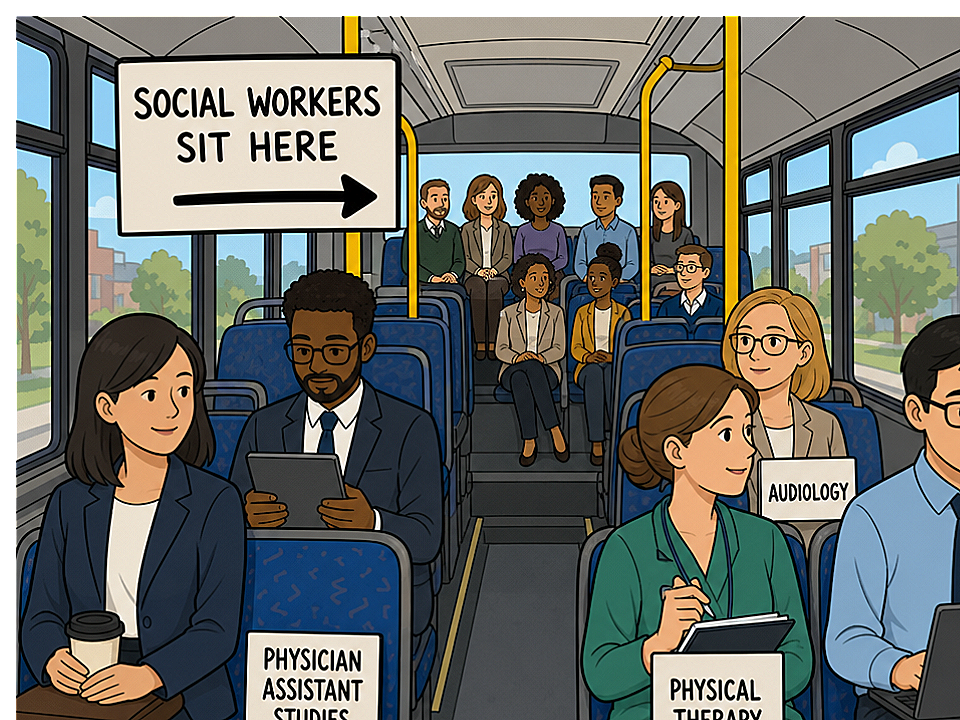
Nurses Sued; Social Work Education Issued Statements: If it were raining that day, we (social workers) would all be wet.
Nurses Sued; Social Work Education Issued Statements
Published July 2026 | Joseph LaFleur, LICSW, MSW, MBA, SEP | District Counseling and Psychotherapy at Joseph LaFleur and Associates
I've written twice now about the federal rule stripping counseling, social work, and nursing degrees of "professional" loan status. Both times I focused on the policy. This time I want to talk about something closer to home, and it's not going to be comfortable for everyone in my own field to read. The fallout touches social work education, early-career clinicians, and students weighing how to enter the field.
What Actually Happened, One More Time
Advanced practice nursing organizations — led by the American Association of Nurse Practitioners (AANP), in coalition with physician assistant and educational bodies — filed their own targeted lawsuit over this rule. They didn't just submit comments. They didn't just release statements expressing concern. They sued, specifically, on advanced nursing's behalf.
Within weeks, a federal judge issued a preliminary stay. The Department of Education responded by expanding the list of qualifying "professional" degrees from 11 fields to 29 CIP codes — and advanced nursing degrees were back on it. The swift shift underscored how coordinated action can shape outcomes for professional programs and, by extension, social work education.
Social work is named in the broader 25-state lawsuit as one of the professions harmed by this rule. That's real, and it matters. But it is not the same thing as social work's own governing bodies organizing independent legal action the way nursing did. The Council on Social Work Education and the National Association of Social Workers wrote statements. They encouraged public comment. Eighty thousand comments were submitted across all affected fields. And the rule was finalized anyway, essentially unchanged, for everyone who didn't have a dedicated legal fight behind them.
Nursing got relief because nursing organized around getting relief. That's not a coincidence. That's cause and effect.
A Personal Note, From One Social Worker to a Profession I Love
I need to say something here as a clinician, not just as someone tracking policy.
I am proud of nurses right now. Genuinely, unreservedly proud. They saw a threat to their profession's future and their students' access to it, and they didn't wait for permission or consensus — they organized, they litigated, and they won a real, material result in a matter of weeks. That is what advocacy looks like when a profession actually believes it's worth defending.
I wish I could say the same about my own profession right now, and I can't. It is long past time for social work to get its act together.
Here's what makes this particularly hard for me to sit with. Social workers are, in my experience, the profession most likely to have Brené Brown's books on the shelf in their office. We quote her constantly — to clients, in supervision, in continuing education. We built entire treatment frameworks around her research on shame, vulnerability, and worthiness. We tell our clients, correctly, that shame resilience means showing up, being seen, and believing you are worthy of belonging and advocacy even when it's uncomfortable.
And then, faced with a federal rule that explicitly devalues our own profession, we wrote statements. We didn't organize a coalition. We didn't sue. We asked nicely and got told no, in writing, on April 30th.
That is a bad case of practicing what we preach and not what we do. If we actually believed what we tell clients about worthiness — that you don't wait for someone else to validate your value before you claim it — our profession's leadership would have been in court alongside nursing, not writing another statement into a public comment file that the Department had already signaled it would ignore.
I don't say this to be cruel to my colleagues. I say it because shame resilience isn't just a clinical tool we hand clients — it's supposed to be something we live by. And right now, collectively, we are modeling exactly the pattern we help clients unlearn: minimizing our own worth, hoping someone else will speak up for us, and calling it humility instead of calling it what it actually is.
Why This Isn't Abstract to Me
I want to be clear that this isn't a new frustration for me, and it isn't limited to student loans. It's the same pattern showing up in a different place, and I've watched it up close.
Several years ago, in the middle of COVID, NASW asked me, as a member at the time, to attend a meeting with the office of Congresswoman Eleanor Holmes Norton about raising Medicare reimbursement rates for clinical social workers to parity with nurse practitioners. Here's the disparity as I understood it then, and as I understand it still applies now: physicians and PhD-level clinical psychologists are reimbursed at 100% of the Medicare physician fee schedule. Nurse practitioners, physician assistants, and clinical nurse specialists are reimbursed at 85%. Clinical social workers are reimbursed at 75%.
The first question I asked in that meeting was the obvious one: why aren't we at 100%? The answer, to the extent I ever got a real one, didn't hold up. The CPT codes for medication management and the CPT codes for counseling and psychotherapy are entirely separate. A social worker — a non-prescribing clinician, by definition — can never bill a medication management code. Full stop. So the reimbursement gap can't be explained by scope of practice, because we were never competing for that portion of the fee schedule to begin with.
And when I look at the actual pedagogy — what nurse practitioners are trained in, versus what clinical social workers are trained in, specifically for counseling, psychotherapy, and case management — social work's clinical training holds up. I've since earned several post-licensure certifications and sat in extended training alongside psychiatrists, psychologists, nurse practitioners, and licensed professional counselors. I did not observe a level of clinical sophistication in that room that would justify a 25-point gap in what our therapy work is worth to Medicare, while theirs is worth full rate.
If you look at the raw numbers, the structural argument is entirely on our side. A clinical MSW curriculum requires a minimum of 900 field education hours focused entirely on the psychosocial architecture of therapy, followed by 2,000 to 3,000 post-graduate supervised hours specifically for clinical licensure. A Psychiatric-Mental Health Nurse Practitioner (PMHNP) track, by contrast, must heavily split its academic credits with advanced pharmacology, pathophysiology, and medical diagnostics, requiring just 500 to 650 total graduate clinical hours across their entire scope of practice. For a federal framework to look at those two training structures and conclude that the path with thousands of hours of dedicated, specialized training in psychotherapy is worth 25% less for a psychotherapy CPT code isn't just bad math—it's systemic devaluation.
I choose to take something positive out of that, honestly. It tells me clinical social work's training in counseling and therapy is on par with what I've seen from psychiatry and unquestionably superior in dedicated volume to nurse practitioners — clinicians with master's-level, specialist degrees, same as us. Which means the honest answer isn't that social workers should move up to 85%. It's that all three tiers doing comparable therapeutic work should be reimbursed at the same rate, and the profession that can't bill medication management shouldn't be reimbursed as though that's the reason it's paid less.
That's the argument I went into that meeting prepared to make. The Congresswoman couldn't attend. An intern sat in for her. The first question that intern asked the room was, "What is social work?" I kept waiting for someone from the social work side to say something like "we'll wait until the Congresswoman is available" — instead, I sat through a conversation that felt like it was happening in a room I wasn't really in, punctuated by faint giggling from the intern and someone else on the other side. It was disheartening in a way that's hard to fully convey unless you've sat in that chair yourself.
Fast forward to this year: there's been essentially no movement on this fix, and it isn't for lack of trying through the polite channel. The bill that would raise clinical social workers to 85% — the Improving Access to Mental Health Act — has now been introduced in five separate Congresses going back to 2017. It has had real, bipartisan sponsorship every time: most recently Senators Debbie Stabenow and John Barrasso, and Representatives Barbara Lee and Brian Fitzpatrick, backed by NASW, CSWE, and a long list of aging and mental health organizations. It has never once made it out of committee. A related version was just introduced in the current Congress under a new name — the Mental Health Access and Provider Support Act of 2026 — carrying the same 75%-to-85% fix. Whether that one moves remains to be seen, but the track record so far is five attempts, zero votes. Compare that to advanced nursing's AANP-driven lawsuit, which produced a federal court order in a matter of weeks. And reading about the current administration's education bill and its treatment of social work — well, you've already read that article. I don't need to say more about it here.
What Embracing Worthiness Would Actually Look Like Here
Not another joint statement. Not another comment period submission after the rule is already final. A dedicated legal coalition — NASW, CSWE, the Association of Social Work Boards, state chapters — putting resources behind a targeted case the way AANP did, arguing specifically that social work meets every substantive criterion for professional-degree status that the Department itself used to justify including other fields.
The template already exists. Nursing wrote it. It worked. There is no clinical or strategic reason social work couldn't do the same thing, except that doing it requires believing, as an organized profession, that we are worth fighting for with the same urgency we ask our clients to find for themselves.
Separate from the legal record, online debate sometimes reduces this issue to slogans or search terms like "trump social work" or "trump big beautiful bill social work." Whatever the headline, the practical path that moved the needle here was organized litigation and professional advocacy, not branding.
I hope we get there. I hope the next update I write says social work found its version of that lawsuit and won its version of that stay. Until then, I'll keep applauding nursing for the model, and keep hoping my own profession decides to actually embrace the worthiness we spend so much of our clinical time teaching other people to believe in.
Q&A
What exactly happened with the federal "professional degree" rule and nursing's response?
A federal rule reclassified counseling, social work, and nursing degrees so they no longer counted as "professional" for loan purposes. Advanced nursing organizations, led by the American Association of Nurse Practitioners (AANP) and its partners, filed a targeted lawsuit. Within weeks, a federal judge issued a preliminary stay (June 24, 2026). The Department of Education then expanded the list of qualifying "professional" degrees from 11 fields to 29 CIP codes, restoring advanced nursing degrees to the list. The rapid shift illustrates that coordinated, field-specific litigation can directly shape outcomes.
Where does social work stand in the litigation landscape right now?
Social work is included as a harmed profession in a broader 25-state and D.C. attorneys general lawsuit (filed May 2026 by a coalition led by the NY Attorney General). However, social work's own national bodies (CSWE, NASW) did not mount a separate, profession-specific lawsuit as advanced nursing did. They issued statements and encouraged public comment. The rule was finalized essentially unchanged for fields without a dedicated legal fight, which is why nursing saw immediate relief and social work did not.
What's at stake for students and early-career clinicians in social work?
The loan classification affects affordability and access to the profession. Nursing's quick legal action produced a material, near-term result for its students (advanced nursing degrees restored to "professional" status), while social work's reliance on statements and public comments did not change the rule. For social work students and new clinicians, that means the financial and entry-path implications remain until and unless the profession secures similar, targeted relief.
What would "embracing worthiness" look like in practice for social work?
Not more statements. The author calls for a dedicated legal coalition—NASW, CSWE, the Association of Social Work Boards, and state chapters—bringing a targeted case that argues social work meets the same substantive criteria the Department used to include other fields. Advanced nursing has already provided a working template: organize, litigate, and seek a stay while pressing the merits. The limiting factor, per the author, isn't strategy but the profession's belief that it is worth fighting for with that level of urgency.
Why invoke Brené Brown's work on shame, vulnerability, and worthiness here?
The author highlights a disconnect: social workers frequently teach and cite shame resilience and worthiness, yet the profession's response to a rule devaluing its degrees was limited to statements and comments rather than visible, vulnerable action (coalition-building and litigation). He argues that "practicing what we preach" means showing up publicly for the profession's value—organizing and acting with the same courage we encourage in clients—so advocacy aligns with the field's core clinical values.